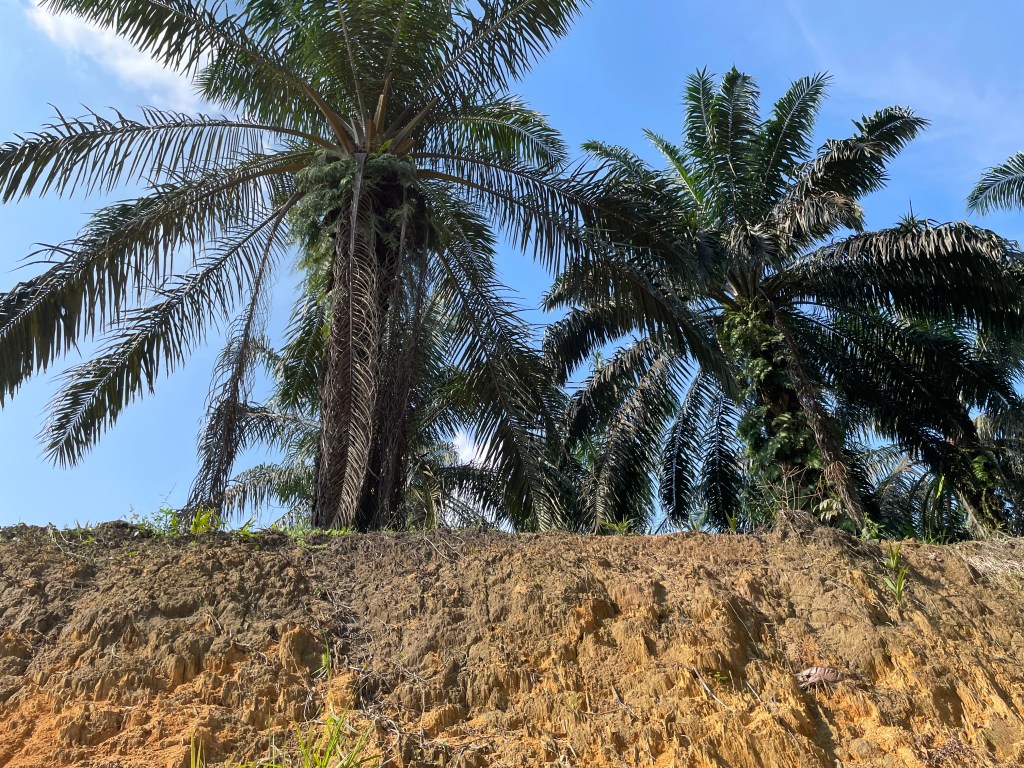
Thank you, A.S & H.S
Vertical integration, no, it’s also the horizontal integration. Either way, no one is mapping anything. What we’ve been doing in oil palm plantations is an inventory of pain and loss. One dead body is too many, but two corpses are for a report evaluation. One should understand: the landscape of this monoculture is borderless, but not necessarily permeable. Fifty kilometres of oil palm plantations are nothing; try this regime of chronotopia that is a slow-paced killing machine: two workers, seven hours, six hectares. Time bends in plantations, and as planners map the gridlock, the plantations creep across the river and agrochemical canals.
She asked us, “Can we produce palm oil without toxins?” He told me, “We’re not dying, but it’s certainly not a welfare.” She confessed, “I’d rather kill myself than see my son breaking his back carrying fresh fruit bunches.” He wept, “I shouldn’t have built that damn pond.” He wept again, “You two were supposed to be twenty-nine together.” You asked me, “Are they killing us?”
That “they” has no face; sometimes it’s the auditor, other time it’s the mandor (overseer). Or a well-mannered old guy with a swagger. In a good time, it’s the state officials. Unsure which one is which, or who does what, workers and farmers agree it’s a “black campaign against palm oil.” They march back to plantations, to an imaginarium of future desperation and past promise. A fugitive — a “Maroon” in some places — once roamed free; now, a fugitive means absolute obedience acquired after a dead son.
His toes rotted, a thorn — which is actually a debris of palm spines — slipped inside his left foot and took a prisoner. An amputated leg is a small price for your son to become a cop or a soldier, it seems. Little did you know, he didn’t become either. He, however, did drink a cup of paraquat because his wife left him for a mandor. He went to the depths of this plantation and never came back; maybe he too had become one of the palms. That’s why there’s only a curse in this land.
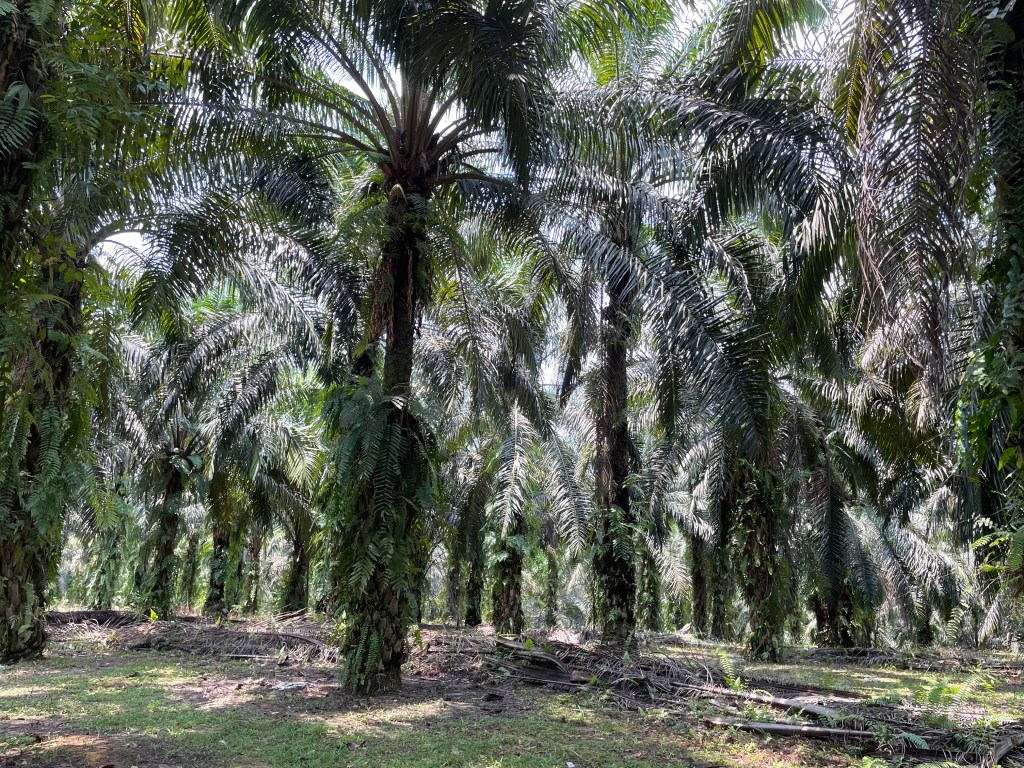
Isn’t it suffocating? This forever chemical, the list of debts that one must pay written on a wage slip, your cancer. Her miscarriage. Their Parkinsonism. While palms are identifiable by their age — the only timescape that matters — workers’ and farmers’ time dissolves. Thirteen years of no security, no pension. Fourteen years of inhaling glyphosate. To understand all of you, all of me, all of us, and less so about me, I need to lie down in this POME pond and take up a ladder to the unruined Babel tower of palm bookkeeping.
Time breaks in the plantations. The past is trapped in layers of made and remade dying soil, the future is being made in coffins of organ trafficking victims, and the present is on the thorns of a false bull. The shimmering, soft light between the palm leaves leads to a mill rather than an end. Under that light, and to each stem, she confided, “I’m in love with him — a quiet raging, hopeless, storm.” Until then, she’s tethered to the shallow root of an oil palm: 350 liters of water/day/palm.
 Pravda Palma
Leave a comment