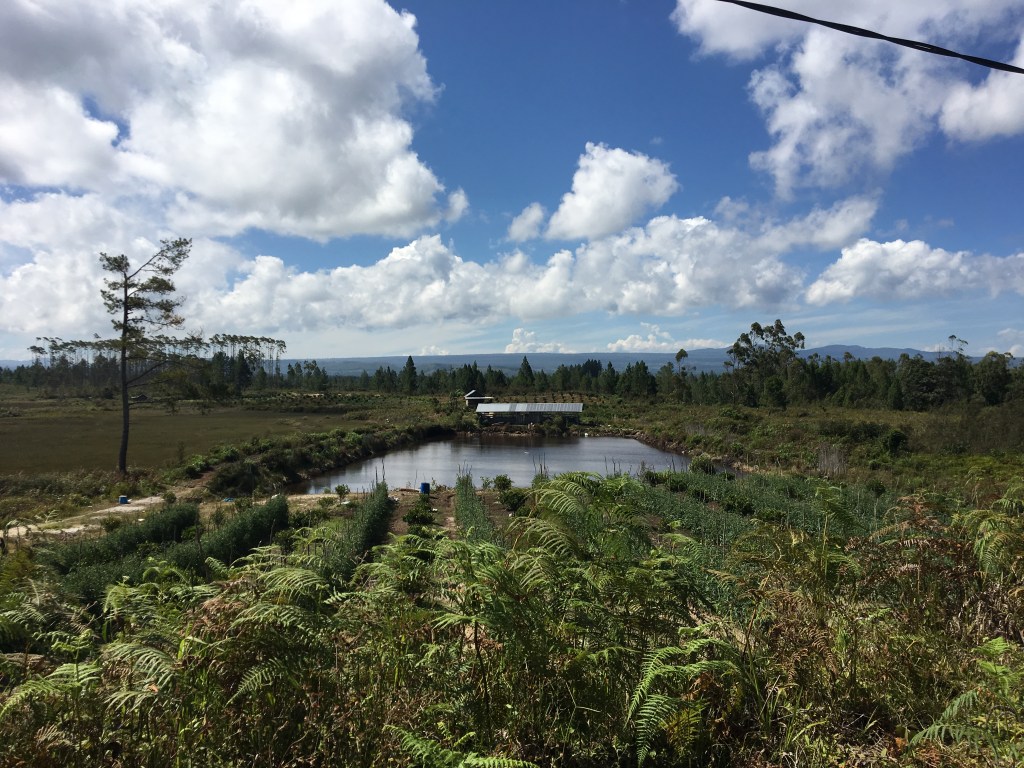
My last meal in Pandumaan-Sipituhuta was a piece of horse meat, provided by my generous and loving host. He said he — a church leader — had blessed the meat, so my journey back home and to the US would be smooth. “Be kind and remember your father, inang.” Both him and my father. So I have done and will always remember. My ethnography in Pandumaan-Sipituhuta was the last ethnography “from below.” Because after the COVID-19 pandemic, it seemed that I stopped being a full-time ethnographer of indigenous and precarious farmers — and I had to swallow the disgust of being in fancy lavish spaces where I had to listen to words such as “sustainability,” “certification,” “shared responsibility,” or whatnot. The village of Pandumaan-Sipituhuta will always be a special place for me, not for just the demography, but how the villages were the last time and place where I felt that I actually discovered & built something helpful for indigenous women in post-land grab recovery and rebuilding.
My thesis was a mess because none of the assumptions prior to the fieldwork landed. Initially, I wanted to study the impact of land distribution on women, in particular, I wanted to study how the victorious case of Pandumaan-Sipituhuta’s Toba communities in reclaiming their customary forest. The mobilization against Toba Pulp Lestari, at this point, has historically been the core of North Sumatrans’ (especially Batak Tobas’) collective memory and actions. Only God herself can forgive this diabolical, evil, and outrageous company. From chemical spilling and poisoning of the Asahan River to beating up indigenous women of Pandumaan-Sipituhuta who blocked company loggers’ trucks. If I see/know any of you being involved in this company — directly or indirectly (especially in its FINANCING) — please be advised to count your days.
Like any ethnography, my research plan fell apart. Despite the heroic—and strategically deliberate—images of Pandumaan-Sipituhuta/Toba women in the mobilization, the customary forest belonged exclusively to Toba men. This is exclusive in the sense that only men could enter the frankincense trees and work there. Of course, this does not apply across North Sumatra and Toba society. There are villages up in northern Lake Toba that allow Toba women to sap and cultivate frankincense trees. Naturally, when the Supreme Court granted the full customary right to Pandumaan-Sipituhuta, I dealt with a “property” that can only be accessed by men. Spiraling down, I sat down by the village road of Sipituhuta and thought maybe I should quit grad school altogether. Then, my informant asked me if I would help her work at her coffee farm, which I joyfully accepted (at this point, my only goal was not to be a useless piece of shit to the villagers). There, she suddenly cried, opened up to me about the grievances that remained even three years after the court decision.
The rest was history; my stubborn ass refused to leave the villages until my own parents had to pick me up for Eid. For 6-8 months, I followed 27 women and recorded their daily activities and labor time by the hour. I interviewed and talked to them while helping them plant and harvest coffee, red peppers, peanuts, and tomatoes. I intruded into their private spaces, interjected into their conversations, and exchanged playful banters and jokes. We criticized each other, they got angry at me for “not coming sooner,” for “not helping better,” for “not giving more,” for “not staying longer,” and for “not getting married to a Batak man” — (or just for not dating at all). We discussed and envisioned what a better future would look like for them. All the court victory, and they still feel like they work themselves to death even more and worse. I want to know why they’re tired. I want to know why women are constantly tired if land ownership does not matter to them, if winning customary forest should be enough for them, if grief and unfair compensation are sacrifice worth making.
When I finished the fieldwork and my thesis, environmental sociology had not been that popular. The pandemic had not hit everyone just yet with the importance of ecological (dis)equilibrium. I felt like a fucking freak in a circus, trying to sell a snake poison, convincing everybody that probably winning over a land grab is not enough because somebody (re: women) gotta pay after. Especially in the discipline of agrarian studies in which the gender dimension is rather miserably underexplored (in a critical manner) beyond women’s role in land justice and movements. I felt hopeless that my research would not land anywhere on any academic platforms. Forget that my framework of socioecological remedy won my very first major research grant. It didn’t matter. Established sociology would not vibe with this work. Or, it was a problem of me being so pigheaded about my writing language, refusing any mainstream sociological lingos and theories to represent my data. This research sat down idly for a while, and I moved on begrudgingly to palm oil plantations.
I still, however, & luckily, presented this research at the Equality Development & Globalization Studies at the Buffett Institute.
Then I met the right people. The generous and intellectually inspiring people who understand my language. Following the mandatory elective course, I took Sociology of Health & Illness, taught by Steve Epstein. I entered the course anxiously because I knew next to nothing about health & medical sociology — but I always heard good things about Prof. Epstein’s pedagogy, teaching, and mentorship, so I took the chance and was honest with him about my limitations. He was really accommodating, and he provided wonderful feedback to my project that was based on my ethnographic fieldnotes on Pandumaan-Sipituhuta women’s health records & complaints as a part of their remaining grief. In the final paper, he encouraged me to polish my paper — it was 2021. I didn’t have any confidence until I saw his comment.
Still, it took me two years to finally submit and showcase my paper with full confidence. The first sign came from Sofyan Ansori — a good friend, an ideal office mate, and a perpetual victim of my scheming and tomfoolery — who invited me to offer a “sociological” (he really did air-quote the word, btw) analysis on environmental narrative. An intriguing topic, and I missed writing in a style of literary criticism and critical theory. So I agreed, and published the first article on my Pandumaan-Sipituhuta, “Queering Ecology: Three Investigations from Indigenous Women in Post-Conflict North Sumatra.” There, I explore how Toba women allowed a limited framework of queerness into their collective work management system, providing them a sense of relief and a caring escape from the burden of community rebuilding.
Maybe it was that article — actually, definitely — that opened the floodgate of people suddenly being interested in my work. I received a small grant from the Land Deal Politics & Initiatives to format my research into academic writing and polish it; and I got the chance to present it at, arguably, the most exciting conference ever in my life: the 2024 Global Land Grabbing Conference at Bogota. Before I knew it, I submitted the updated version of my Sociology of Health course to the International Quarterly for Asian Studies, got accepted, and now it’s online, making it the second installment of the Pandumaan-Sipituhuta research: “Now I am Constantly Sick”: Environmental Degradation and the Impact on Toba Women’s Health after Land Conflict.” I am currently working on a revision for the third and final series of this research, in which I explain the cause and the mechanism of the disproportionate effects of land grabs on women and their perpetuation through labor time. Who knows if it’s going to be published and when — but one thing for sure, I am absolutely thankful for the people who see the potential in my research (and being so patient with me delaying so many things given the grief and whatnot), no matter how shoddy my writings were. Thanks for understanding that I move at my own pace, not whatever this neoliberal academic’s temporality.
So, the third publication is out in the Journal of Agrarian Change. I’ve been reading this journal since before grad school, and now I have a publication for/with them. Nightmares do come true. The editorial process, however, was not a nightmare; it was lovely and kind. It is extremely rare of me to change my writing rule, and here I am finally cool with a paragraph with more than 200 words. I am thankful for the LDPI who provided me the writing/research grant and allowed me an opportunity to submit my writing for the journal’s special edition on Indonesia’s rural labor. BW & JP, the issue editors, trusted me once again with my timeline. When they sensed something off about my pace, BW gently — but straightforwardly — reminded me why I needed to write. They saw the potentials in every paragraph I wrote, and helped me strengthen my point, so my argument and my proposed method-framework come stronger. “Mending the Broken Clock: Gender & Socioecological Changes in Postconflict North Sumatra” is now available in Journal of Agrarian Change. It’s open access, thanks for Northwestern’s money.
 Pravda Palma
Leave a comment